

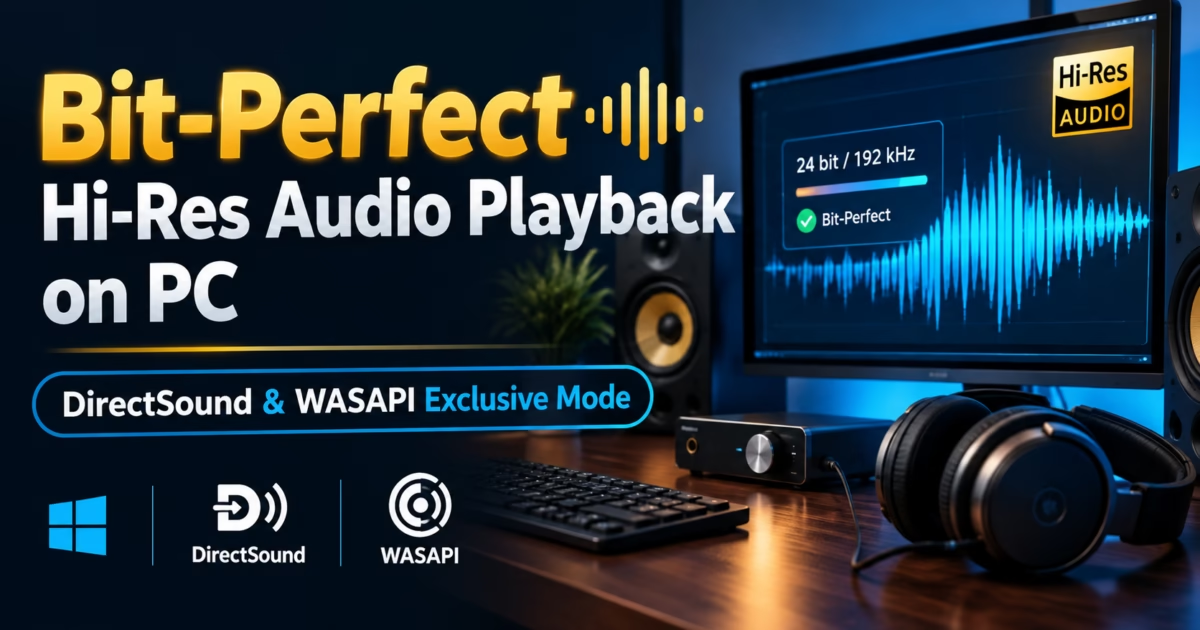
To Play Audiophile FLAC recordings with authentic studio master fidelity on modern Windows 11 systems, music enthusiasts must bypass the digital signal resampling imposed by the default Windows Audio Session API mixer. Standard desktop operating systems automatically force all audio streams through a unified software mixer, degrading high-resolution 24-bit/192kHz audio into quantized 48kHz streams that introduce subtle harmonic distortion and inter-sample peaks. Consequently, discerning listeners using external digital-to-analog converters (DACs) require dedicated hardware-level audio routing that delivers pure, unadulterated bitstreams directly from storage drive to sound card.

Play Audiophile FLAC: Bypassing the Windows Software Audio Mixer
When you listen to high-resolution music on a standard personal computer, Windows routes digital audio through the Windows Audio Engine (audiodg.exe). This subsystem provides convenient operating system functions, such as blending Spotify music with Discord notifications, video game sound effects, and browser chimes. However, to accomplish this simultaneous playback, the operating system converts every incoming audio stream to a single common denominator sample rate—typically 48,000 Hz at 16-bit or 24-bit floating point precision.
Specifically, when you attempt to Play Audiophile FLAC tracks recorded at 44.1kHz (Red Book CD audio) or 96kHz/192kHz (high-resolution studio masters), the Windows software mixer applies non-integer polyphase sample rate conversion. Because 44,100 does not divide evenly into 48,000, algorithmic interpolation recalculates audio waveforms on the fly. This mathematical approximation generates micro-jitter, introduces low-level quantization noise, smudges transient attacks, and destroys the delicate stereo soundstage meticulously crafted in mastering studios.
Furthermore, default Windows sound settings frequently activate hidden digital enhancement DSP effects. These include loudness equalization, virtual surround virtualization, and room acoustic correction filters that alter the frequency response curve. For true audiophiles seeking transparency, listening through this shared mixer negates the thousands of dollars invested in premium planar magnetic headphones, electrostatic monitors, and high-performance ESS Sabre or AKM DAC chips.
Bit-Perfect Audio Transmission: Demystifying WASAPI Exclusive Mode & DirectSound
To preserve genuine acoustic integrity, specialized desktop media players utilize WASAPI Exclusive Mode or low-latency direct hardware streaming protocols. WASAPI Exclusive mode allows a dedicated media player application to seize sole, uninterrupted control over the audio endpoint hardware. Under this operational architecture, the Windows audio mixer is completely bypassed.
As a direct consequence, the exact digital PCM sample stream stored within your lossless FLAC, ALAC, or WAV file is transferred bit-for-bit across your USB connection into your external DAC receiver buffer. If your track is encoded at 24-bit/192kHz, the DAC hardware clock automatically locks onto 192,000 cycles per second. If the subsequent playlist entry is a standard 16-bit/44.1kHz track, the DAC oscillator gracefully switches clock frequencies without any software resampling or bit truncation. This pristine transmission mode is formally known in high-fidelity engineering as Bit-Perfect Playback.
In addition to mathematical bit precision, exclusive hardware routing isolates audio rendering threads from desktop UI overhead. Windows multimedia scheduler services (MMCSS) assign the highest execution priority to audio buffers, effectively eradicating buffer under-runs, crackles, and micro-pops caused by background software updates or CPU load spikes.
Architectural Comparison: Shared OS Mixer vs. Hardware Direct Bitstream
High-Resolution Decoding: 24-Bit / 192kHz & DSD Master Files
High-resolution audio formats offer an extraordinary dynamic range and acoustic airiness that compressed MP3s simply cannot replicate. A 24-bit FLAC audio file provides an astonishing 144 dB of theoretical dynamic range, compared to 96 dB for 16-bit CD audio. This immense dynamic floor allows classical symphonies to transition from whisper-quiet solo woodwinds to thunderous orchestral climaxes without introducing audible background hiss or digital clipping.
Moreover, high sample rates like 96kHz and 192kHz capture frequencies well beyond the standard human hearing threshold of 20,000 Hz. While humans do not consciously perceive a 40kHz tone directly, ultrasonic harmonics influence how phase relationships and audible transients are rendered within the time domain. Nyquist-Shannon reconstruction filters operate with substantially gentler roll-off slopes at 192kHz, completely eliminating the harsh phase distortion and high-frequency ringing characteristic of steep 44.1kHz brick-wall filters.
Therefore, a professional desktop player must incorporate asynchronous decoding engines capable of unpacking lossless FLAC frames in real time without CPU stuttering. Efficient media players pre-load compressed audio frames into an ultra-fast RAM ring-buffer, isolating disc I/O operations from real-time playback buffers. As a result, even when running heavy background video rendering or compiling code on Windows 11, high-resolution audio streams remain silky-smooth.
DSD vs. PCM: Direct Stream Digital & DoP Tunneling Mechanics
In addition to multi-bit PCM audio, audiophile libraries frequently incorporate Direct Stream Digital (DSD) master recordings originally mastered for Super Audio CD (SACD) formats. Unlike PCM, which samples signal amplitudes across 16 or 24 parallel binary bits at discrete intervals, DSD utilizes 1-bit delta-sigma modulation operating at ultra-high sample rates. Standard DSD64 records at 2.8224 MHz (64 times the sampling rate of a standard audio CD), while DSD128 and DSD256 operate at 5.6448 MHz and 11.2896 MHz respectively.
Because standard Windows audio drivers only understand linear multi-bit PCM packets, transmitting native 1-bit DSD bitstreams to an external DAC requires specialized encapsulation protocols. The most reliable method is DSD over PCM (DoP), formalized by audio engineering consortia. Under the DoP architecture, 16 bits of 1-bit DSD data are packaged alongside an alternating 8-bit marker byte into standard 24-bit PCM frames.
When these frames pass through USB interfaces, the receiving DAC detects the alternating DoP marker bytes and routes the underlying 1-bit stream directly into its analog low-pass reconstruction filter. If a media player fails to implement DoP validation, attempting to play DSD files produces ear-piercing white noise. Piludi Media Player incorporates built-in DoP encapsulation and high-precision DSD-to-PCM conversion filters for systems lacking native DSD silicon decoders.
USB Audio Class 2.0 & Asynchronous DAC Clock Synchronization
Another crucial factor in achieving pristine acoustic fidelity is clock synchronization between your desktop computer and your external audio hardware. In legacy synchronous USB audio transmission, the computer’s motherboard clock dictates the pace at which audio packets are delivered. Because motherboard crystal oscillators are subject to intense thermal fluctuations, radio frequency interference from graphics cards, and fluctuating power rails, synchronous audio streams suffer from timing jitter.
Modern audiophile sound cards utilize USB Audio Class 2.0 (UAC2) in Asynchronous Mode. In asynchronous mode, the external DAC completely ignores the computer’s internal clock. Instead, high-precision femtosecond crystal oscillators inside the DAC control digital-to-analog conversion timing. The DAC actively commands the desktop media player when to send the next packet of audio samples through a dedicated USB feedback endpoint.
Consequently, clock jitter is isolated to sub-picosecond thresholds, completely eliminating the blurred instrument separation and flattened acoustic depth caused by noisy PC power supplies. Piludi Media Player fully respects UAC2 asynchronous feedback loops, maintaining rock-solid synchronization across multi-hour listening sessions.
Dynamic Range Compression vs. Studio Master Crest Factor
Commercial radio broadcasting and modern streaming algorithms often apply aggressive dynamic range compression (DRC) to make tracks sound louder than their competitors. This phenomenon, known historically as the “Loudness Wars,” squashes the dynamic peaks of musical performances, shaving off transient impact from snare hits and orchestral bass drums. In contrast, uncompressed audiophile FLAC studio masters maintain high crest factor ratios—frequently exceeding 14 dB to 20 dB between average RMS energy and peak signal levels.
When a music listener enables shared mixer sound settings on Windows, operating system audio protection limiters automatically apply peak compression to prevent clipping when alert sounds interrupt music playback. This unintentional compression flattens the crest factor of high-resolution recordings. In contrast, routing audio through Piludi’s hardware-exclusive direct stream ensures that zero dynamic compression is applied. Transient attacks retain their full acoustic punch, allowing drum cymbals to shimmer naturally and acoustic upright basses to resonate with authoritative depth.
Room Acoustics, HRTF Spatialization & Parametric EQ Calibration
Even with bit-perfect hardware output, the acoustic environment between your speaker transducers and your ears introduces frequency non-linearities. Room boundary reflections generate standing waves and bass room modes that can boost 60 Hz or 120 Hz frequencies by as much as 15 dB while hollowing out critical mid-range vocals. Similarly, high-end planar magnetic headphones possess unique impedance characteristics and treble resonance peaks at 6 kHz or 8 kHz.
To overcome physical listening environment flaws without introducing phase distortion, Piludi Media Player features a 64-bit double-precision parametric equalizer (PEQ). Listeners can import industry-standard AutoEq calibration profiles tailored to over 4,000 distinct headphone models. By applying surgical minimum-phase biquad filters, Piludi smooths out mechanical driver resonances, aligning frequency response curves to the renowned Harman Target Curve for optimal tonal balance.
Audio Resampling Filters: Linear Phase vs. Minimum Phase FIR Architectures
When digital audio decoders must resample audio—for instance, when rendering a 96kHz stream through an older 48kHz audio interface—the interpolation filter design plays a fundamental role in subjective acoustic clarity. Traditional digital audio workstations apply symmetric Linear Phase Finite Impulse Response (FIR) brickwall filters. While linear phase filtering preserves exact time alignment across all frequencies with zero group delay distortion, it inevitably produces symmetrical pre-ringing artifacts—acoustic energy that echoes slightly before high-energy transient strikes like snare drums.
In contrast, acoustic research into psychoacoustics reveals that the human auditory system naturally masks post-ringing (decay after a sound) through backward temporal masking, but cannot mask unnatural pre-ringing. Piludi Media Player incorporates selectable Minimum Phase FIR filtering options. Minimum phase filters concentrate all filter ringing after the transient event, ensuring zero pre-ringing, razor-sharp drum impacts, and organic musical timing that closely mirrors physical acoustic instruments in natural concert halls.
CUE Sheet Splitting & Embedded Album Image Decoding
Many collector audio archives store full vinyl rip albums or classical concert performances as a single continuous multi-gigabyte FLAC file accompanied by an external metadata `.cue` sheet. Standard Windows media players treat the entire 60-minute file as a single monolithic track, making it impossible to navigate between individual songs or view track-specific performer credits.
Piludi Media Player features intelligent virtual CUE parsing. When an album image file is loaded, the engine dynamically calculates index offset timestamps without modifying the underlying FLAC master on disc. It populates an interactive playlist with individual song titles, track lengths, and gain tags. Furthermore, Piludi parses embedded non-destructive picture blocks, rendering high-resolution front covers, back liner notes, and CD booklet scans in crisp detail.
Step-by-Step Guide: Configuring Hardware Audio Output with Piludi Media Player
Achieving bit-perfect fidelity does not require managing complicated legacy ASIO drivers or spending hours tweaking open-source command line scripts. Follow these streamlined steps to set up audiophile hardware playback:
Step 1: Connect Your External USB DAC or Sound Card
Connect your external USB digital-to-analog converter directly into an unobstructed motherboard USB port. Avoid unpowered USB multi-hubs, which can inject electrical ground loop noise and 5V USB bus ripples into sensitive analog stages.
Step 2: Launch Piludi Media Player & Open Audio Preferences
Launch Piludi Media Player on your Windows 11 desktop. Navigate to Settings > Audio Engine Configuration.
Step 3: Select Direct Hardware Endpoint & Exclusive Mode
Under Output Device, change the dropdown from Primary Sound Driver (Shared) to your specific DAC hardware interface with Direct Hardware Exclusive Stream enabled. This disconnects the operating system mixer immediately.
Step 4: Enable Gapless Audio Playback & Memory Caching
Toggle Gapless Audio Decoding to “Enabled” to eliminate 2-second silence intervals between consecutive live concert or concept album tracks. Enable 256MB RAM Pre-Buffering to ensure zero disc-access jitter.
Acoustic Driver Protocols: WASAPI vs. ASIO vs. Kernel Streaming
Windows power users frequently debate the relative merits of different low-level audio driver architectures. Understanding the technical nuances among these three driver protocols ensures optimal hardware performance:
Gapless Playback, High-Dynamic Range Equalization & Album Art
A true audiophile listening session involves more than pure mathematical bitstreams; it requires an immersive listening experience. Classical operas, live symphonies, and progressive rock albums (such as Pink Floyd’s The Dark Side of the Moon) rely on continuous acoustic transitions between tracks. Standard Windows media players pause for several hundred milliseconds when closing one audio file handle and initializing the next, completely ruining musical momentum.
Piludi Media Player employs a synchronized dual-thread decoding buffer. While Track 1 is concluding its final 3 seconds, the background engine pre-decodes the initial uncompressed PCM frames of Track 2 into memory. When the sample counter reaches the track boundary, output buffers splice seamlessly with zero millisecond latency, delivering 100% genuine gapless playback.
Furthermore, metadata matters. High-bitrate audio files frequently incorporate high-resolution embedded album artwork, booklet PDFs, and comprehensive ID3v2/Vorbis comment metadata tags (including composer, conductor, recording venue, and dynamic range DR values). Piludi’s modern Windows 11 Fluent UI interface renders high-resolution cover graphics with hardware-accelerated Direct2D canvas smoothing, giving you a beautiful desktop turntable visual experience.
Frequently Asked Questions on Audiophile PC Playback
Does WASAPI Exclusive Mode disable my browser audio and Discord?
Yes. By design, when you establish exclusive hardware mode to stream bit-perfect music, your playback software seizes dedicated hardware control over that specific sound card. Any other application attempting to play sound through that same DAC will be muted until playback pauses. You can configure Windows to route voice chat through motherboard headphone outputs while sending music exclusively to your USB DAC.
Why is FLAC superior to uncompressed WAV for storage?
FLAC uses lossless Huffman coding and linear predictive coding algorithms that compress audio file sizes by 40% to 60% without modifying a single digital bit. When decoded in memory, FLAC outputs the exact bit-for-bit PCM bitstream as raw WAV. In addition, FLAC possesses robust metadata tagging standards, whereas standard WAV files offer inconsistent and easily corrupted metadata support.
Do I need expensive audio cables for bit-perfect USB transmission?
No. Digital USB audio transmits discrete binary packets (1s and 0s) governed by strict checksum validation protocols. A properly shielded, compliant USB 2.0 cable provides identical bit-perfect data transmission compared to multi-hundred-dollar boutique cables. Acoustic improvements come from high-quality DAC clocks and robust analog amplification stages, not esoteric USB wire jackets.
Can high sample rate playback damage headphones or speakers?
No. High sampling rates (such as 96kHz or 192kHz) simply capture ultrasonic frequencies with greater mathematical precision. Transducers and headphone voice coils naturally roll off acoustic output above their mechanical frequency limits without sustaining electrical damage, provided output amplifiers are operated below their analog clipping thresholds.
Official Software Hub Access & Windows Desktop Installation
Ready to elevate your desktop audio experience and experience your music collection in pure studio-grade resolution? Experience the speed and clarity of a dedicated modern Windows 11 native player. Explore our complete desktop catalog on the DesignoFly Studio Software Hub, and download Piludi Media Player today for permanent unrestricted access to high-fidelity playback.
Published by: DesignoFly Studio Team • Verified on Windows 11 • Technical Reference: Microsoft Core Audio APIs WASAPI Architecture